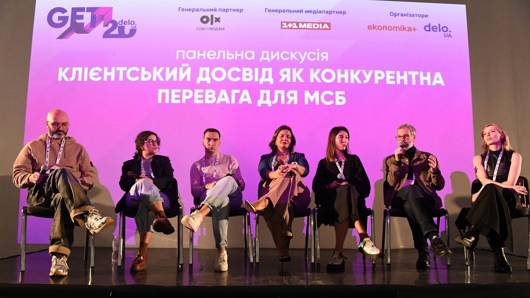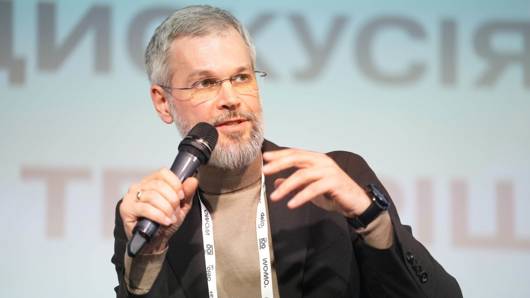

Oleksandr Vodoviz, head of the Chief Executive Officer’s Office at Metinvest Group, spoke about the state of Ukraine’s industry, wartime losses, investment barriers and export risks in 2026 at the “Ukraine and the World Ahead 2026” event organised by NV and The Economist.
The event gathered Ukrainian and international experts together with government and business representatives to discuss the key challenges that will shape the country’s development in the year ahead.
On the Group’s transformation
Vodoviz stated that the war has fundamentally changed Metinvest’s scale and capabilities. Before the full-scale invasion, the Group was one of the country’s largest private employers and investors, as well as a leading exporter. During the war, however, it has lost the use of some of its assets, including the complete disruption to operational control of its facilities in Mariupol, while its total workforce has fallen from 120,000 to 50,000. More than 11,000 Metinvest employees have served in the Armed Forces of Ukraine, and a significant number remain on active duty.
Despite substantial reductions in personnel and production capacity, Metinvest remains a key player in Ukraine’s economy and the country’s largest exporter, with assets located just tens of kilometres from the front line.
On investments halted by the war
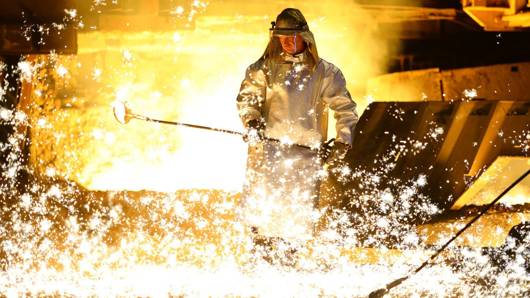
Until 2022, Metinvest had invested around US$1 billion annually to modernise its steelmaking and mining operations, fully replacing Soviet-era infrastructure. The situation today is fundamentally different. The Group has effectively shifted into survival mode and has been operating at a loss for two consecutive years.
Investment plans for 2026 are limited and focus solely on maintaining existing operations, Vodoviz stated. The main reason is the complete lack of access to international financing. Global banks and investment funds are unwilling to commit capital to projects located near active combat zones. Meanwhile, Ukraine still lacks effective mechanisms for war-risk insurance to cover investments.
Even large international programmes such as the Ukraine Facility or partner-backed credit initiatives have had little practical impact on heavy industry. Their funding is disbursed slowly and rarely reaches industrial enterprises.

On the threat posed by CBAM to Ukraine’s exports and economy
Vodoviz identified the EU’s implementation of the Carbon Border Adjustment Mechanism (CBAM) as a separate risk for the steel industry. The mechanism imposes additional charges on imported steel and other energy-intensive goods based on their CO2 emissions.
For Ukrainian steelmakers, this would mean a significant increase in production costs, potentially making their products uncompetitive in the European market: Ukraine’s key export destination. Exporters could face additional charges of EUR50-100 per tonne of steel. In the longer term, this burden threatens lower exports, shutdowns at certain facilities and job losses.
Metinvest is exploring future-oriented options, including producing hot-briquetted iron (HBI), a low-carbon product that could find demand in the EU. However, implementing such projects also requires substantial investment and partnerships, which remain unattainable without effective war-risk insurance mechanisms.
On the labour shortage and the inability to launch new projects
Even before the war, Ukraine’s industrial sector faced a shortage of skilled labour. Today, the situation has become critical. Due to mobilisation, the emigration of young people and the closure of specialised educational institutions in industrial regions, it is now nearly impossible to recruit the staff needed for major investment projects.
Constructing even a single new blast furnace requires several thousand specialists: engineers, machine operators, fitters and equipment technicians. The labour market cannot supply such numbers, and the sector lacks tools to rebuild its workforce quickly.
On energy resilience and investment in self-generation
Russia’s ongoing attacks on energy infrastructure continue to disrupt steel plants: shutdowns caused by power outages result in significant financial losses. Just a few days of downtime at major facilities can cost tens of millions of dollars.
In response, the Group is developing its own energy projects – including solar and wind installations, backup power systems and other decentralised generation sources – to strengthen production resilience.
On support for the armed forces
Metinvest continues to be one of the largest private donors to the Armed Forces of Ukraine. The scale of support directed towards military needs, humanitarian programmes and assistance to the families of fallen service members is comparable to the Group’s wartime investment budget. Metinvest’s facilities produce protective structures, drones, fortification solutions and other assets critical to the front line.
Conclusion
Ukraine’s industrial sector is entering 2026 in a state of profound uncertainty. Metinvest, as one of the pillars of the national economy, emphasises that without solutions for war-risk insurance covering investment, stabilisation of the energy system, genuine access to international finance programmes and an effective labour policy, a rapid industrial recovery is unrealistic.
Despite extremely challenging conditions, the Group continues to sustain production, support the Armed Forces of Ukraine and seek new opportunities for development, while calling on the state and international partners to provide more robust economic and institutional support.