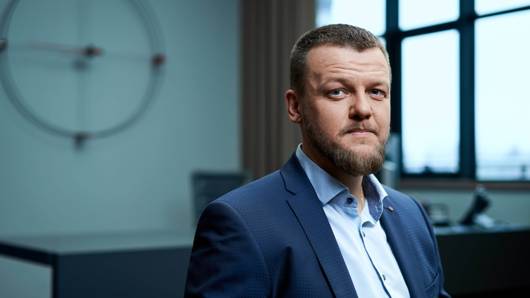
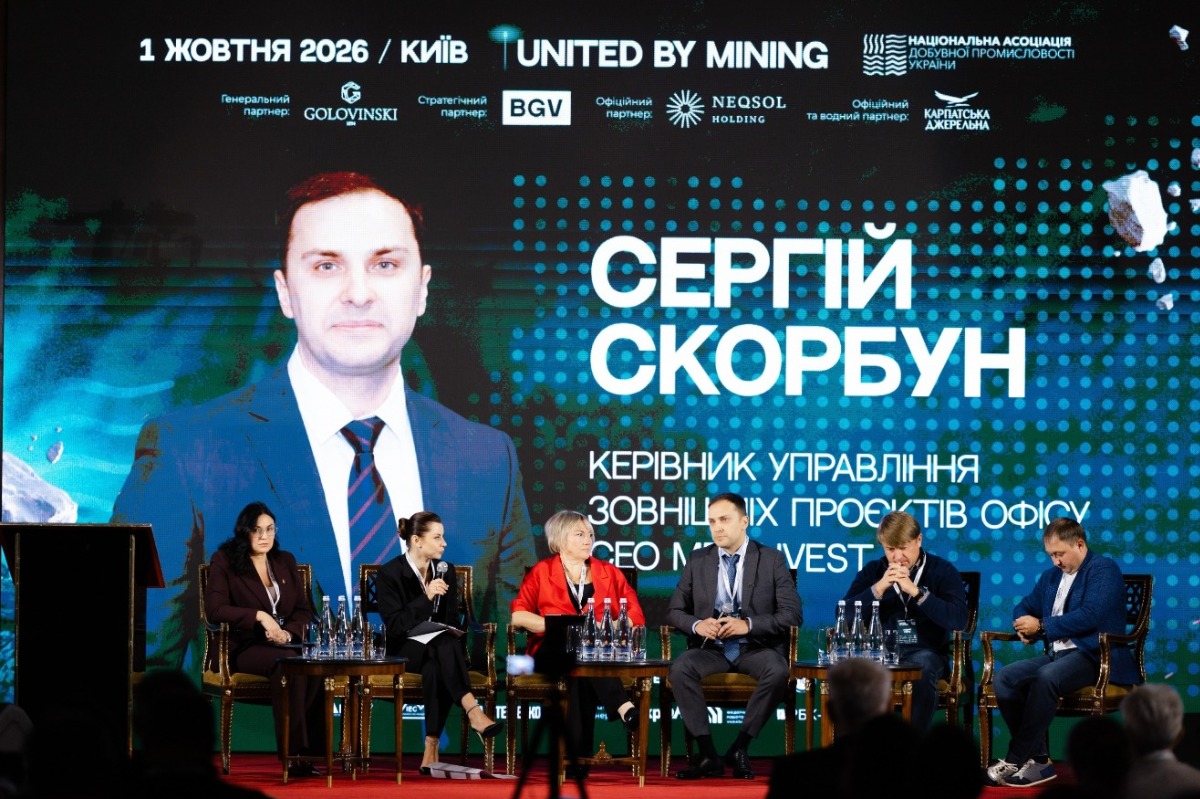
Serhii Skorbun, Head of External Projects at the CEO's Office of Metinvest Group, spoke at the United by Mining forum in Kyiv about the conditions needed for the industry to survive and for the facilities damaged by Russian attacks to be restored.
The event brought together representatives of government, business, investment companies, industry associations, and technical universities. Participants discussed the resilience of the mining industry during the war, the recovery and modernisation of the resource sector, decarbonisation and CBAM, as well as attracting investment and integrating Ukraine into global value chains. The forum was organised by the National Association of Extractive Industries of Ukraine.
Serhii Skorbun took part in the panel discussion "Resilience – Standing Strong". The discussion also included representatives of the Verkhovna Rada Committee on Energy and Housing and Utilities Services, Marhanets Mining and Processing Plant, and the trading house "Holovynskyi".
About risks and people
According to Serhii SKORBUN, security risks are fundamentally different from ordinary business risks that can be factored into when planning a company's operations.
"No business assumes in its business model that it will come under missile attacks. We used to factor in risks such as rising gas prices or price drops. But we could never have anticipated direct strikes that would destroy core production facilities," he said.
Therefore, he says that the first prerequisite for preserving production is security and the ability for the business to operate in a predictable environment.
Despite operating at a loss, Metinvest continues to retain its workforce wherever possible. For industry, the loss of skilled professionals can become an irreversible problem.
"We have been in survival mode all this time. We are doing everything we can to retain our people. We understand that equipment is nothing without people," said Serhii Skorbun, Head of External Projects at the CEO's Office of Metinvest Group.
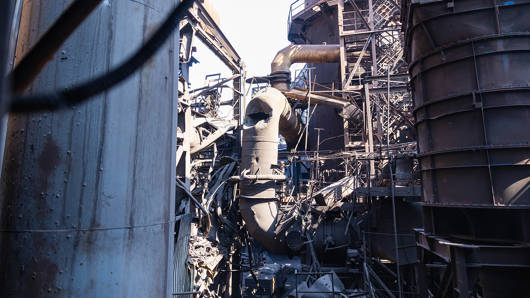
In particular, Zaporizhstal, whose operations have been halted due to Russian attacks, employs around 8,000 people. They include steel workers, foundry workers, rolling mill operators, locomotive drivers, and representatives of thousands of other professions.
"If these people leave, it will be a disaster, because rebuilding that skilled workforce is extremely difficult," Serhii Skorbun said.
On the scale of support
Large industrial enterprises are the lifeblood of local economies and budgets. For decades, they have been contributing significant tax revenues and supporting regions. At the same time, both the state and the business have fewer and fewer resources to sustain them: the company no longer has the financial cushion that enabled it to sustain the operations of its enterprises during 2022-2023. This is why the state needs to find support instruments that are commensurate with the scale of such enterprises.
For example, the government's loss compensation programme caps support at $10 million per company. For a large metallurgical enterprise, this amount does not correspond to the scale of potential losses: one blast furnace costs $100-150 million.
"Then the question is: does Ukraine need its large enterprises? If it is not possible to compensate 100%, then compensating 20% is also a solution. While this would not completely resolve the issue, it would enable us to repair some of the equipment," he said.
The restoration of a large enterprise has an impact on the entire production chain, from repair companies to raw material producers and the railway sector.
"A single steel plant provides work for countless other businesses – everyone around it stays operational. If the state caps support at $10 million, it effectively means that there is no place for large businesses in Ukraine. I believe this approach needs to be revised," Serhii Skorbun said.
On monopoly tariffs
Metinvest remains committed to investing in the recovery of its production facilities and continues to pursue its green transition strategy. However, the implementation will depend on whether the company can get through the current period and preserve the foundation for future investment: its people, assets, suppliers, and contractors.
According to Serhii Skorbun, rising electricity and rail freight tariffs will be among the factors determining the capacity to undertake new investments.
For example, at Ukrenergo, the bulk of the costs are fixed, and only a small portion depends on volumes of electricity transmitted. When transmission volumes decrease, costs remain largely unchanged, so the company compensates for them at consumers' expense.
The same is happening with Ukrzaliznytsia: freight volumes are declining, while tariffs for the companies that continue to operate are increasing.
High tariffs are eroding the competitiveness of Ukrainian industry. Amid the war, this is an additional factor that investors consider alongside security risks.
"Our tariffs are already higher than those in Poland and Slovakia. If we continue down this spiral, businesses will start asking themselves whether it still makes sense to enter Ukraine, invest, and build new plants. From electricity to rail transportation, there are countless factors that show that doing business here is simply expensive. On top of that, there are the risks. And the question is: who will invest in such an economy?" said Serhii Skorbun.
It is therefore essential to preserve the competitiveness of Ukrainian industry. At the same time, the most energy-intensive enterprises require a separate approach, as electricity accounts for a significant share of their production costs.
On infrastructure support
Metinvest does not expect the state to support critical infrastructure entirely from public funds. At the same time, part of this support could be secured from international partners.
"We understand that the state currently lacks the resources to support Ukrzaliznytsia or Ukrenergo. But it is possible to seek assistance from our partners. For example, by consolidating $500 million a year for Ukrzaliznytsia, given the role it plays for the country. It is not only freight transportation, but also passenger services, evacuation trains, and transportation for the Defence Forces," said Serhii Skorbun.
A similar approach is also needed for the energy infrastructure as a temporary instrument to navigate the crisis.
"We understand that once the war ends, the attacks stop, the regions rebuild, mining and processing plants resume operations, and the ports are restored, consistent revenue flows will recover. But until that happens, we need to find some instruments," he noted.
On the CBAM and steel import quotas
At the same time, some of the problems can be resolved without public funding. In particular, this concerns Ukrainian industry's access to the EU market, which is constrained by the CBAM levy and steel import quotas.
"There are things that can be done for the business even without spending money. If the EU revises quotas for us, the steel industry will gain momentum. That will translate into orders for iron ore, ferroalloys, limestone, and coking coal. This is how the economy gets moving. But for that to happen, Ukraine must continue its negotiations with the European Commission," Serhii Skorbun explained.