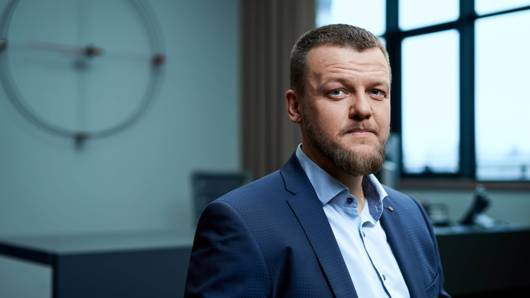

Oleksandr Vodoviz, Head of the CEO’s Office at Metinvest Group, recently spoke to the Polish business portal Strefa Biznesu about the critical state of Ukraine’s steel industry, production stoppages caused by Russian attacks, cost optimisation, dependence on imports and new EU trade restrictions.
Will Ukraine’s steel industry survive?
– Russia has once again attacked the Zaporizhstal steelworks. What is the situation now, and is there any chance of restoring production?
– The situation is indeed very difficult. Ukraine has three major steelmaking enterprises: ArcelorMittal in Kryvyi Rih, Kamet Steel in the Dnipropetrovsk region and Zaporizhstal. These are integrated steel plants using conventional iron ore-based steelmaking technologies. Following the latest attacks, only one enterprise remains operational – Kamet Steel – which is running at 40% of capacity.
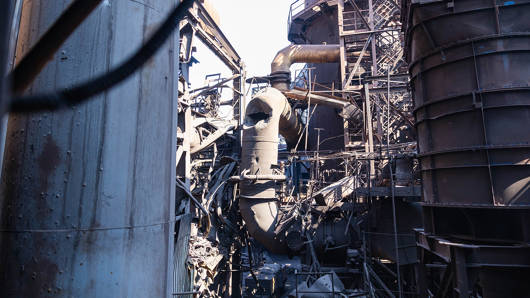
[Clarification: the interview took place before the Russian attack on Kamet Steel on 5 September, which killed five people and injured four others. Due to the extensive damage, the plant suspended production, and it remains unclear when operations will resume. In addition, on the night of 12 September, Russian forces launched four ballistic missiles at the already idled Zaporizhstal plant, causing critical damage to the blast furnace shop, energy and logistics infrastructure, and injuring four employees. On 17 September, Russia again struck the plant with two ballistic missiles, damaging core production and auxiliary equipment, production buildings and railway infrastructure, and injuring one employee.]
The Russians know that the steel industry is extremely important to Ukraine. They are targeting industrial facilities, while drones and missiles fly over the area every day. The plant in Zaporizhzhia is currently not operating. The situation is so difficult that the question now is whether Ukraine’s steel industry will survive at all. We cannot simply stop operations and then restart the plant once conditions improve.
The furnaces have been destroyed, and the steel structures have also sustained serious damage. People have been killed at the plant. From the moment the air-raid alert was issued, there were only two minutes to reach a shelter. Will we try to restart the furnaces? At present, we do not see any way to do so. Perhaps in the future.
– How many people does your company employ in Ukraine? Will some of them lose their jobs as a result of the destruction? If so, what scale of workforce reductions are we talking about?
– Metinvest employs around 50,000 people, including those currently serving in the Ukrainian defence forces. Until the last possible moment, we tried to avoid redundancies. However, today, to survive, preserve production and protect thousands of jobs, we have to reduce costs, optimise business processes and reduce headcount, primarily in areas where workloads have fallen significantly. We will support the employees affected: they will receive compensation and, where possible, we will offer them vacancies at other production facilities within the Group.
– Who was your largest customer?
– Zaporizhstal supplied products to many countries around the world, and the EU was its main sales market. We have many customers in the EU who will now no longer be able to receive our products.
Last year, we acquired a pipe plant in Romania. Under our original plan, Zaporizhstal was to supply sheet steel to this facility. However, the Romanian plant is now operating at a lower level of output. New EU quotas have already restricted supplies of Ukrainian raw materials, while Russian missile strikes on our facilities in Ukraine are creating additional risks for these supplies. If we are unable to provide the plant with sufficient raw material, it may ultimately have to cease operations.
– What about supplies to the domestic market?
– We will import steel from Türkiye and South Korea. I do not know whether EU steelmakers are prepared to replace our supplies. I do not think so, because they are less competitive on price. They have their own well-developed market.
Instead of domestic production: imports from Türkiye and South Korea
– What do you mean by “less competitive on price”? Will Türkiye be able to supply steel to Ukraine more cheaply?
– Yes. EU producers have their own well-developed market, where prices are higher, and they would be less competitive on price in Ukraine. Suppliers from Türkiye or South Korea can offer more competitive prices. So, if domestic production disappears, Ukraine will become increasingly dependent on imports from those markets.
– Is there demand for Ukrainian steel in the EU?
– Every country looks after its own producers and its own economy. What does the EU do? It looks after its own steelmakers. Some are not operating, while others are undergoing bankruptcy proceedings.
The EU believes that total steel imports should amount to 18 million tonnes: no more than that. This volume is then allocated among countries in the form of quotas. Ukraine is permitted to supply 600,000 tonnes of steel. On the one hand, Brussels says that it sees Ukraine as part of the EU; on the other hand, the quotas are distributed unfairly.
The quotas were introduced in July. When they were allocated, account was taken of the volumes of steel that different countries had traditionally supplied to the EU, the level of duties that had applied over the previous two to three years, as well as Ukraine’s potential supply volumes compared with those of other countries: Türkiye, South Korea and India. And what happened? Türkiye exhausted its entire quota within the very first week.
We would like the EU to respond to this. Ukraine is at war. We are not thinking about how to compete; we are thinking about how to survive.
This December, the EU will decide whether these quotas should be reduced or increased. The decision will be based on the volume of supplies from Ukraine during the six months preceding December. We effectively have only one steelmaking enterprise operating, so it is obvious that supply volumes will be lower. The decision taken in December will remain in force for the next five to ten years. We are concerned that we may not have enough time to do anything about it.
We also believe that the Carbon Border Adjustment Mechanism is unfair to Ukraine. Brussels has spent around EUR1 billion on reducing emissions at its own steelmaking facilities. Ukrainian plants have received no such support, while missiles and drones fly overhead every day. Perhaps the EU could consider temporarily exempting Ukraine from this mechanism?
While we are prepared to reduce emissions, we do not currently have the financial resources to do so. We are raising this issue in Brussels and in Ukraine, but we do not see any indication that anyone is listening to us.
We need to find solutions that protect the industry
– Since we have already touched on quotas: from 1 January 2026, Ukraine introduced a zero quota on exports of steel scrap to the EU. Poland formally challenged this decision before the European Commission, arguing that the ban breaches the EU-Ukraine Association Agreement. Is everyone simply looking after their own interests? What are Polish-Ukrainian relations like in the steel industry?
– As I have already said, every country looks after its own economy and its own producers. Poland does this, the entire EU does this, and Ukraine must do the same. But that does not mean that our industries cannot cooperate.
Poland and Ukraine are already closely linked. For example, Ukraine buys coking coal from Poland. As Ukraine moves closer to EU membership, we need to find solutions that protect our industries while at the same time allowing this cooperation to develop.
– What losses have you suffered since the beginning of the war? Have you assessed them?
– Our losses since the beginning of the war run into billions of dollars.
– Should Russian assets frozen in the West be released and transferred to Ukraine?
– This is a difficult political issue. I would rather not go too deeply into politics. As a Ukrainian, I believe they should. We have suffered losses, our economy has been devastated and our country has been destroyed. Someone must pay for this. Whether anyone actually will is a difficult question. And it is a question not only for Ukraine, but also for the EU and the US. However, this is not only about Russian assets. It is also about Ukraine itself and access to funding: financing from the EU and its banks, which is currently very limited. Why is that? Because EU companies are afraid of the war. The EU says: we have given you EUR90 billion, use it as you see fit. The question is whether those funds are being spent effectively.
I believe that preserving Ukraine’s steel industry is also in the interests of the EU. In that case, the EU may ultimately need to spend less on keeping Ukraine functioning.
Before the war, the steel industry was the largest taxpayer to Ukraine’s state budget, while Metinvest was Ukraine’s largest steel exporter. If the steel industry declines, tax revenues will fall. Overall, the industry contributed around UAH200 billion to the state budget.
Of course, we are grateful to both Poland and the EU. Without this EUR90 billion, Ukraine might no longer exist.
– How is the Ukrainian government supporting the steel industry?
– All government financing programmes are focused on small and medium-sized businesses rather than large enterprises. There are no programmes for companies such as Metinvest. The steel industry has effectively been left to deal with its problems on its own.
While I criticise this, at the same time, I understand the problems facing the state budget. It has an enormous deficit. There is not even enough money to purchase Patriot missiles, let alone provide support for the mining and metals sector. But if the state supported this industry, more money would flow into the budget. It is a vicious circle.
Huta Częstochowa: not for the defence industry
– I would also like to ask about Huta Częstochowa. You had planned to acquire this steelworks, but the deal did not go ahead.
– Back in the spring, we wanted to acquire the plant. We said that Poland’s Ministry of National Defence did not necessarily need to become its owner. We were prepared to invest EUR200 million.
– The Polish government is providing financing to the plant, but the enterprise is operating inefficiently. The plant is supposed to produce steel for the defence industry.
– If we are talking about 300 tanks, and each one requires 40 tonnes of steel, that amounts to 12,000 tonnes: a volume the plant can produce in a week. I am referring to its current production level. What happens during the rest of the time? We explained that this plant is not intended for the defence industry. The government made its decision, and now I read in the Polish press that it is having problems with the plant.
Defence requirements are not a sufficient reason to acquire a steel plant. At least, they should not be the main reason.
– What, in your view, would be the right approach?
– The right approach would be for it to operate as a normal steelmaking business. We have customers across Europe and supply products for shipbuilding and construction. The plant should be owned by a major industry player that knows how to produce steel, how to sell it and how to reduce losses.
– As I understand it, you are also abandoning plans to acquire the steelworks in Košice, Slovakia?
– Today, our priority is to survive and preserve production. We will be ready to consider other opportunities again, depending on how the situation develops.
– And what about the reconstruction of Ukraine? Do you think EU companies will be interested?
– I do not see a queue of investors here. Memoranda are being signed, but until the war ends, no one is going to come from Wrocław or Katowice to Zaporizhzhia. People simply want to live. Ukrainians have become used to something constantly flying overhead. People in the EU will not risk their lives.
Oleksandr Vodoviz has worked at Metinvest since 2008: initially as a senior analyst, later as Head of Trade Finance and Strategic Project Finance at Metinvest International, and also as Head of Investments at Metinvest. Before joining Metinvest, he worked at Galnaftogaz as an economic analyst and manager.